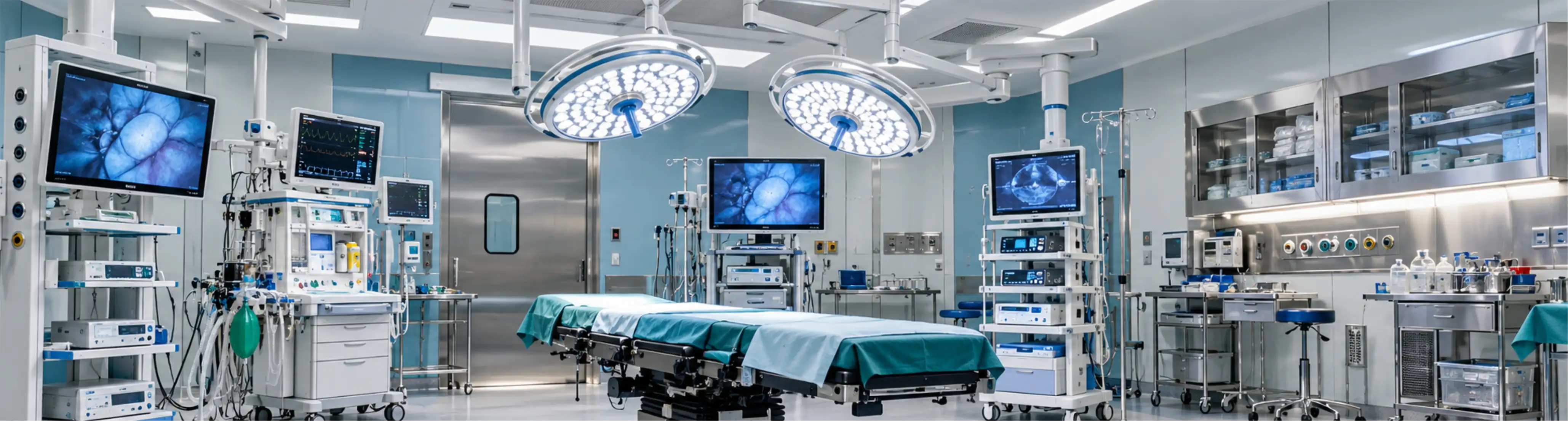



Infection is a major concern in any operation, and the room is the first line of defence. Apex’s modular operation theatres are engineered to meet strict international standards for surgical safety and infection control. Their modular build uses fitted panels with smooth, joined surfaces, so there are few gaps where dirt can collect and cleaning is easier. A laminar air flow system directs filtered air in one steady direction over the operating area, and advanced HEPA filters trap very fine particles before they reach the patient. Surgeons use these theatres for high-complexity open surgery as well as keyhole procedures. During the operation, anaesthetists and nurses stay with the surgical team the whole time, and when it is over, the patient is moved to a recovery area where observation carries on.
A worn knee can turn everyday things like walking to the market or using stairs into a struggle. For some patients, replacing the damaged surface of the joint is what restores movement. Apex Group of Hospitals has Cuvis robotic joint replacement setups for knee resurfacing. The surgeon plans the operation and stays in charge, while the robotic system helps guide the work on the bone so the cuts and the implant position are more exact. Because the damaged part can be targeted closely, there is usually less harm to the tissue around the joint, and recovery tends to be shorter. Not every knee needs this treatment, so an orthopaedic doctor first examines the joint and reviews the patient’s overall health before suggesting surgery.
Some operations no longer need a large cut. Apex Group of Hospitals has laparoscopy and endoscopy suites for minimally invasive surgery, where the surgeon works through a few small openings or natural body passages. A thin tube with a camera is passed inside, and the picture appears on a screen, so the surgeon can see the area in sharp detail while operating with fine instruments. Smaller entry points usually mean less damage to the tissue around the problem area. Patients often have less pain after the procedure and may leave the hospital sooner than they would after open surgery. Some conditions still need open surgery, so the surgeon makes that call only after examining the patient and going through the test results and scans.
Looking inside the body does not always require a large cut. Endoscopy and laparoscopy are two ways of doing it, and Apex Group of Hospitals has dedicated suites for both. During an endoscopy, a slim, flexible tube fitted with a light and a camera is passed through a natural opening like the mouth, which lets the doctor study the food pipe, stomach or intestines on a screen. Laparoscopy is a surgical technique. A few tiny cuts are made in the abdomen, and the surgeon works with a camera and fine instruments while following the images on a monitor. The enlarged, clear view helps the team operate carefully, and the small openings leave the surrounding tissue less disturbed, so recovery is often quicker. The choice of procedure depends on the symptoms, the test findings and the patient’s overall health.
