Jun 29, 2026 | By Admin
Your doctor says you need an endoscopy.
Or maybe it is a colonoscopy.
You nod and then quietly wonder:
“Wait, aren’t those the same thing?”
They are not.
And the difference matters quite a bit depending on what your doctor is trying to find.
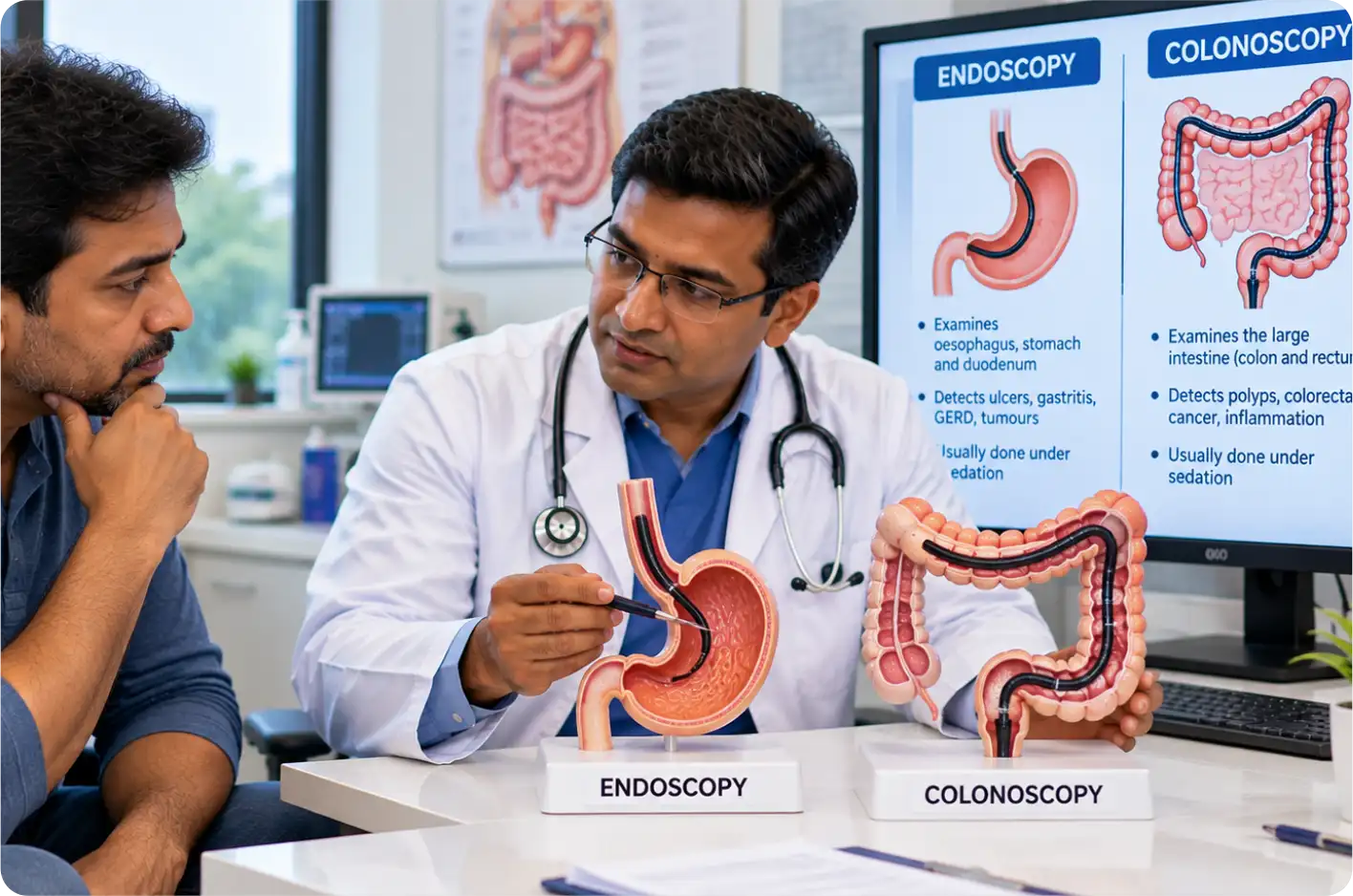
Both are diagnostic procedures. Both involve a thin, flexible camera being guided into the body. But they look at completely different parts of the digestive system, and are used for different reasons.
Here is what you need to know.
An upper GI endoscopy (also called an OGD, oesophago-gastro-duodenoscopy) is a procedure where a flexible camera is passed through the mouth to examine:
The oesophagus (food pipe)
The stomach
The upper part of the small intestine (duodenum)
During the procedure, the doctor can also take a tissue sample (biopsy) if something needs further examination.
Duration: Usually 15 to 30 minutes. Done under light sedation, most patients feel little to no discomfort.
A colonoscopy is a procedure where a flexible camera is passed through the rectum to examine:
The entire large intestine (colon)
The rectum
Sometimes the very end of the small intestine
Duration: Usually 30 to 60 minutes. Requires bowel preparation the day before.
Sometimes, yes. If a patient has symptoms that could indicate issues in both the upper and lower digestive tract, or if an investigation needs to be comprehensive,
both procedures may be recommended.
This is not unusual and does not automatically mean something serious, it simply ensures nothing is missed.
Both endoscopy and colonoscopy are routine, well-established diagnostic procedures performed safely in hospitals every day. Serious complications are rare. The brief discomfort of preparation and recovery is far outweighed by the value of accurate diagnosis.
Digestive symptoms that are ignored often get worse, or mask something that, if caught early, is highly treatable.
Do not delay investigation because the procedure sounds intimidating. In most cases, it is straightforward, quick, and gives your doctor the answers they need to help you properly.
If you have been experiencing persistent digestive symptoms or are due for a routine colorectal screening, consult our Gastroenterology Department at Apex Hospital for a proper evaluation and guided care
If you have persistent digestive symptoms or need guidance about endoscopy, colonoscopy or colorectal screening, consult the Gastroenterology Department at Apex Hospital for expert evaluation and personalised care.
